
Summer Reading List 2026: Staff Book Picks on Educational Justice
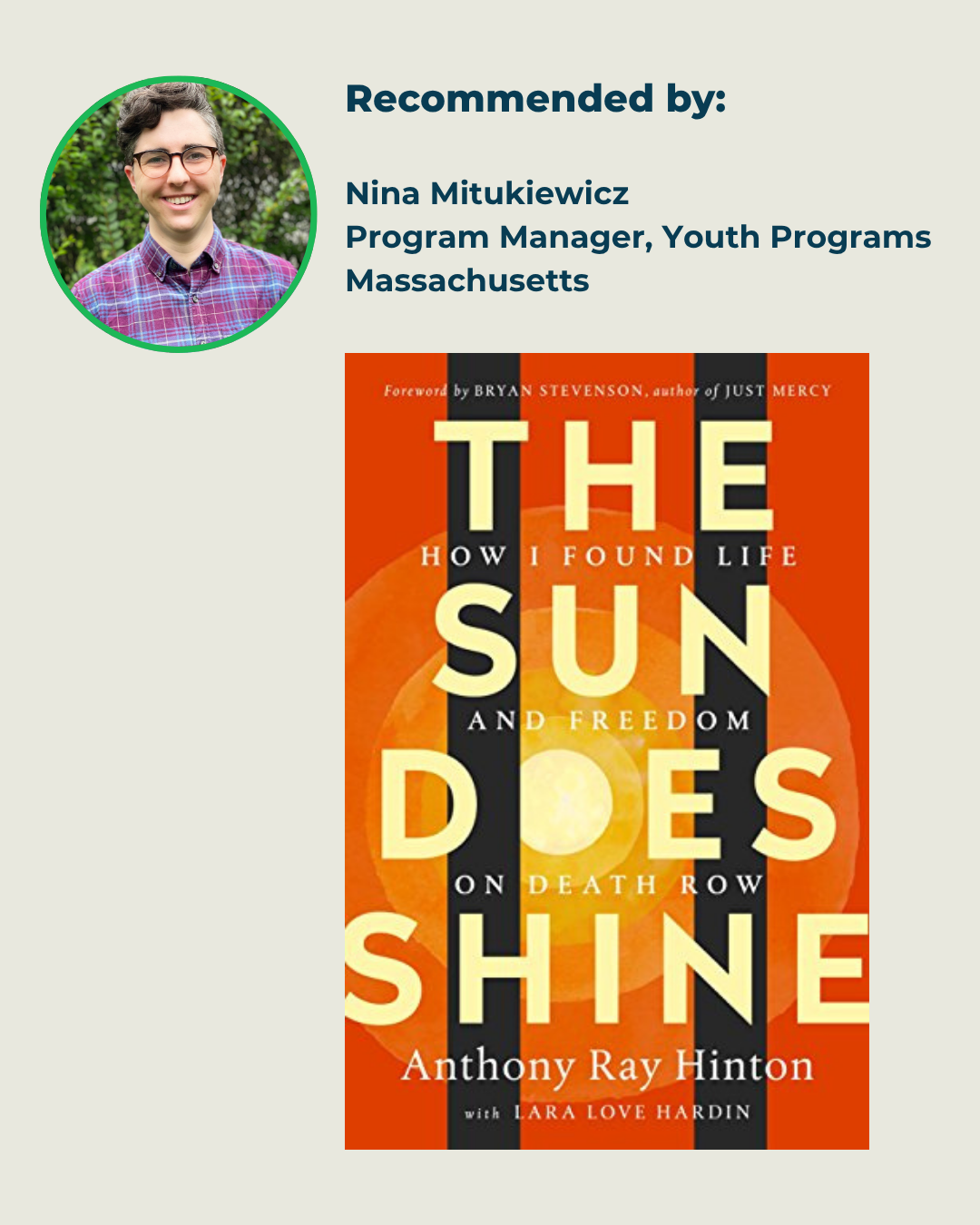
The Sun Does Shine: How I Found Life and Freedom on Death Row
Anthony Ray Hinton | Memoir
As the summer winds down, we’re highlighting four powerful books that deepen our understanding of the criminal-legal system, educational justice, and human resilience. These are staff recommendations—complete with key takeaways, discussion questions, and quotes.
The Sun Does Shine: How I Found Life and Freedom on Death Row
The Sun Does Shine is an extraordinary memoir detailing Anthony Ray Hinton’s 30-year journey on Alabama's death row for a crime he did not commit. Sentenced to death in 1985 for two capital murders based on faulty ballistics evidence and systemic bias, Hinton spent decades fighting for justice with the help of civil rights attorney Bryan Stevenson and the Equal Justice Initiative. He was fully exonerated and released in 2015. Nina points to the book as an essential read for anyone passionate about criminal justice reform, emphasizing how Hinton’s story illuminates systemic flaws while highlighting how strength and resilience can sometimes prevail.
"I recommend this book because it focuses on a story that is often overlooked or forgotten about in the system: Anthony Ray Hinton spent 30 years on death row for a crime he didn't commit. It is a heavy story of injustice, while simultaneously shedding light on the unwavering hope of the human spirit."
Beyond exposing the devastating impacts of wrongful conviction, Nina notes that reading Hinton’s story in his own words grounds the conversation in the reality of lived experience: "Reading this story in Anthony's voice is a powerful reminder that those closest to the criminal-legal system (and those most unjustly affected by it) should be at the forefront of any and all efforts for reform and change."
Discussion Questions
In what ways does reading Hinton’s story in his own voice change or deepen your understanding of the criminal-legal system compared to reading statistics or policy reports?
Hinton spent 30 years on death row despite evidence of his innocence. What systemic failures and racial biases contributed to his wrongful conviction?
While on death row, Hinton started a book club—reading works by James Baldwin, Maya Angelou, and others. Why do you think he did that? How does Hinton’s death row book club demonstrate the transformative power of education and community within carceral spaces?
Memorable Quotes
"Despair was a choice. Hatred was a choice. Anger was a choice. I still had choices, and that knowledge rocked me."
"It’s hard to explain exactly what it feels like to be judged. There’s a shame to it. Even when you know you’re innocent."
Learn More & Get Involved
Find it at a library.
Visit the Equal Justice Initiative to read more about Ray Hinton’s case.
Apply to be a PGP volunteer tutor or support our educational programs.
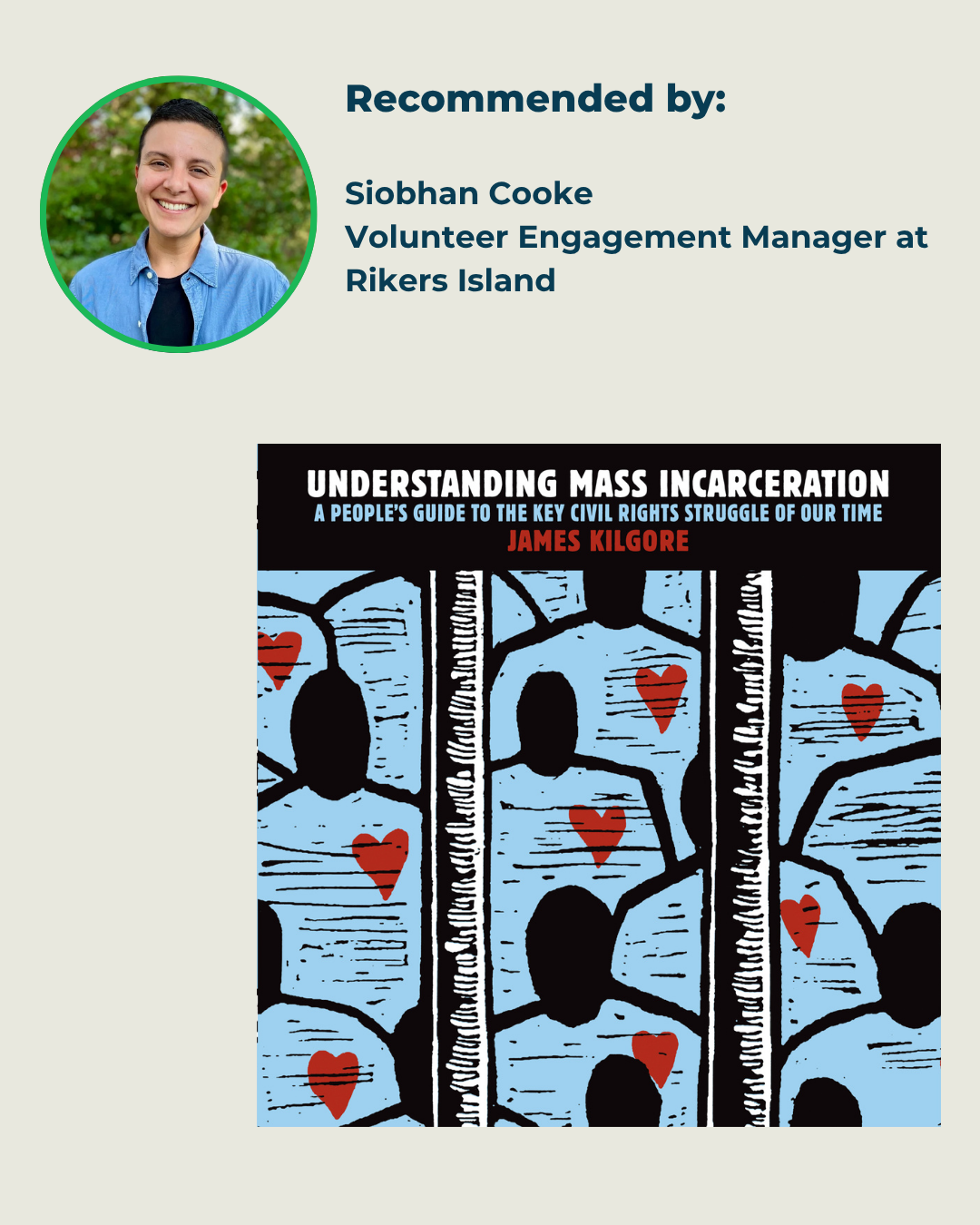
Understanding Mass Incarceration: A People’s Guide to the Key Civil Rights Struggles of Our Time
James Kilgore | Nonfiction
Understanding Mass Incarceration: A People’s Guide to the Key Civil Rights Struggles of Our Time
Understanding Mass Incarceration provides an accessible, comprehensive overview of how the United States built the world's largest prison system. Drawing on his experience as both an educator and someone who spent years inside the system, author James Kilgore breaks down complex topics—including the political and cultural shifts driving mass incarceration, the school-to-prison pipeline, women in prison, immigration detention, the war on drugs, private prisons, and activism around prison reform and abolition—into a clear and nuanced framework.
Why Siobhan Recommends It
Siobhan selected this book for our staff Diverse Dialogues series to help ground our collective work in a shared vocabulary around the carceral state, praising Kilgore’s ability to make intricate systems understandable without sacrificing depth:
"I chose this book for staff to read because I think it is important for PGP staff to have a shared vocabulary around the carceral state. One of the things I love about this book is its clarity and accessibility. Kilgore takes a really complicated issue that has a lot of intertwined systems and elements propping it up and writes about it in a way that is straightforward yet still nuanced."
Siobhan also highlights how Kilgore captures the complexity of the topic by fostering dialogue rather than presenting rigid conclusions:
"Kilgore writes in his introduction, 'having spent many years of my life both inside and outside prison as an educator, I've approached each topic in this book by trying to create dialogues for the reader among the various opinions, rather than attempting to offer all the answers (as if anyone really has them).' I really love how Kilgore captures the complexity of this topic by putting different perspectives into conversation with one another. I also appreciate how the book can serve as a primer on the topic of mass incarceration but also a great resource to people who have been engaging in these conversations for a while."
Discussion Questions
On Shared Vocabulary: Kilgore emphasizes creating a common understanding of the carceral state. Which terms or concepts in the book broadened or reframed your perspective on the criminal-legal system?
On Nuance and Dialogue: How does Kilgore’s approach of putting different viewpoints into conversation help you navigate complex debates around prison reform versus abolition?
On Lived Experience in Education: Kilgore draws on his experience as both an educator and an incarcerated individual. How does lived experience shape effective advocacy and educational work within carceral spaces?
On Intersectional Issues: Kilgore examines specific sub-topics such as the war on drugs, immigration, and women in prison. Which of these areas do you feel requires more urgent focus in educational and advocacy initiatives?
Memorable Quotes
“The prison system could not have expanded without considerable amounts of popular support. Gaining support for mass
incarceration was a complex, prolonged, and intentional process, one that is often ignored in analyses of the criminal justice system.”
“A key social change underlying the advance of mass incarceration has been an increasing respect for the absolute authority of the law and those involved in law enforcement. This attitude has not always prevailed.”
“In the 1970s, most sociologists and criminologists linked crime to social problems. They believed that it grew out of poverty, inequality, and lack of opportunity. Furthermore, they argued that crime and punishment reflected the racial and class fault lines in U.S. society. The mainstream political rhetoric of the 1980s encouraged a heightened sense of individual responsibility for crime. From this perspective, people turned to crime not because of lack of opportunity or obstacles such as racial or class discrimination, but because they made "bad choices." Under this punishment paradigm, halting crime came down to teaching ‘criminals’ to accept responsibility for their actions, take their punishment, and then turn their lives around. “
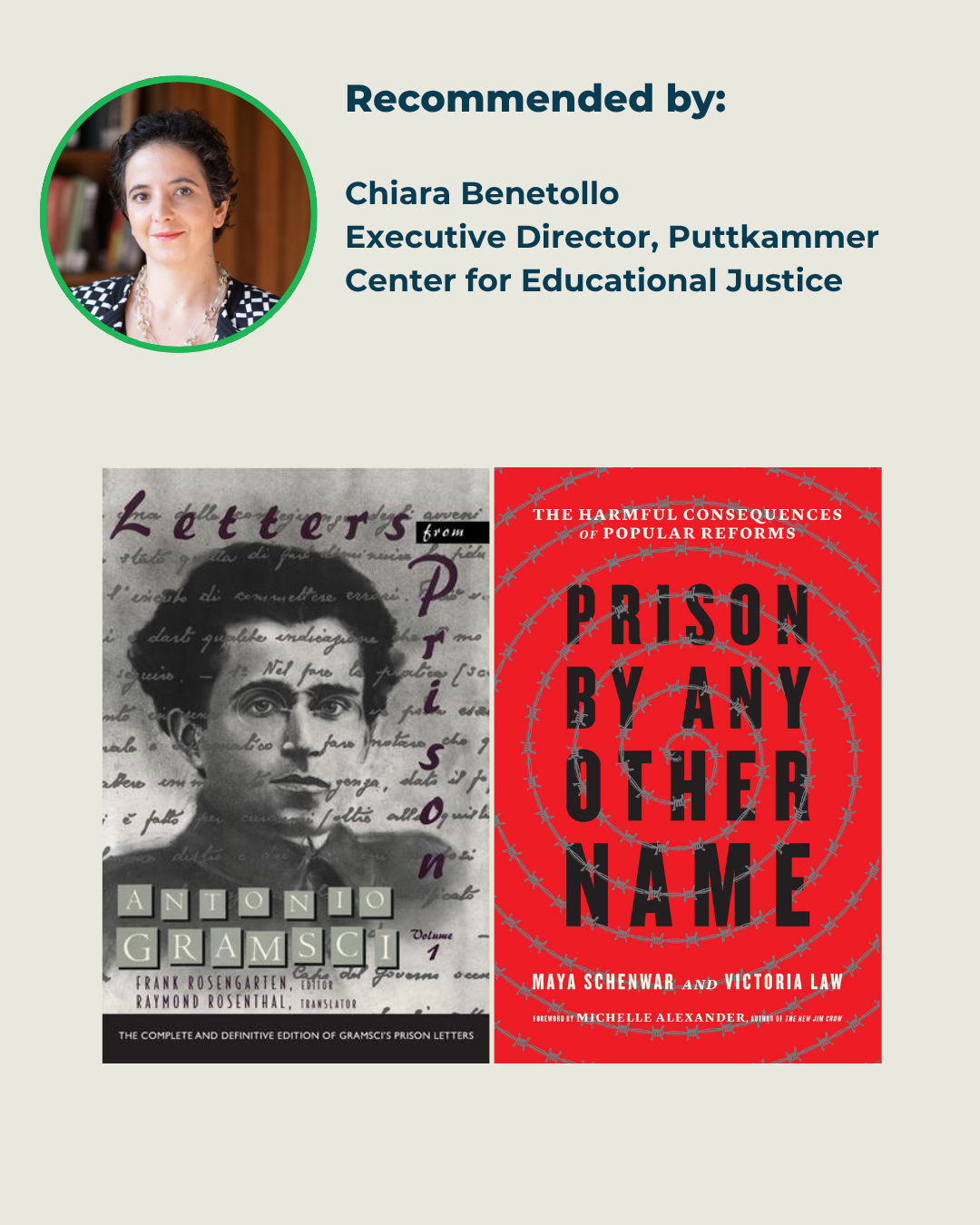
This week, Chiara Benetollo shares two recommendations that explore the reach of the carceral state, the power of intellectual connection while incarcerated, and the shared burden carried by loved ones on the outside.
Letters from Prison and Prison by Any Other Name
Prison by Any Other Name by Maya Schenwar and Victoria Law: An insightful examination of how popular reform measures—such as electronic monitoring, community supervision, and treatment mandates—often expand state surveillance and extend the reach of the carceral system without addressing the underlying drivers of mass incarceration.
Letters from Prison by Antonio Gramsci: Written while Gramsci was held as a political prisoner in Italy, this collection of personal letters to family and friends details the physical and emotional hardships of confinement while highlighting how reading, learning, and maintaining relationships provided profound strength and purpose.
Why Chiara Recommends Them
Chiara selected these texts to prompt critical reflection on system reform while celebrating the transformative role of education and solidarity across time and space:
On Prison by Any Other Name: Chiara notes that this book is essential for understanding "how so-called alternatives to prison often end up expanding surveillance and the reach of the carceral state, without really addressing the root causes of mass incarceration".
On Letters from Prison: Recognizing it as a quirkier yet deeply personal choice, Chiara shares: "Gramsci’s letters are deeply moving, especially those to his family and friends. He talks about the physical and psychological deprivation of incarceration, but the best parts are those in which he continues to build connections with people outside, and where he describes the strength that he derives from studying and learning. I find it moving to think about how his words resonate with what we hear from our students."
Discussion Questions
Critiquing Alternatives: How do reform proposals like electronic monitoring risk expanding carceral control rather than shrinking it, and how can advocacy efforts guard against net-widening?
Education as Strength: Gramsci emphasized that studying and intellectual connection brought him calm and purpose during imprisonment. In what ways does this resonate with PGP’s educational mission and student experiences?
Memorable Quotes
"My state of mind is such that, even if I were sentenced to death, I would continue to feel calm and even the evening before my execution perhaps I'd have a Chinese language lesson." — Antonio Gramsci
“There is unique gravity to an actual prison sentence, the violence of locking a human being in a cage. Yet the system is broader than the buildings called "prisons." Manipulation, confinement, punishment, and deprivation can take other forms - forms that may be less easily recognized as the violence they are.” — Maya Schenwar and Victoria Law
“Monitors and house arrest aren't rehabilitative or transformative - they don't support people in making changes that would be helpful to their lives, gaining needed resources, addressing harm or violence, or confronting the social forces that affect them.” ― Maya Schenwar and Victoria Law